


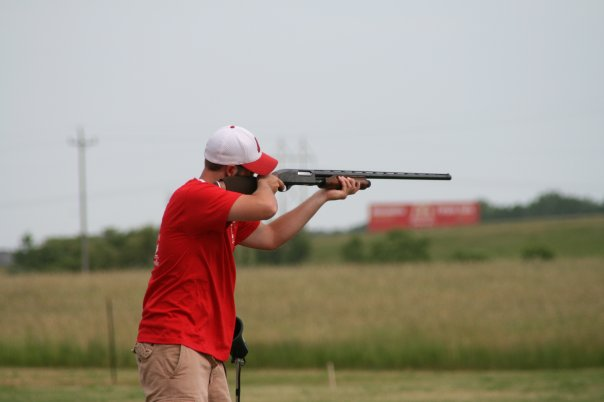
Over the past couple months, stores have cyclically run out of the basic necessities. Shelves have been emptied of canned goods, pasta, bread, and, infamously, toilet paper. A few other commodities have experienced a run as well, notably firearms and ammunition. Many of those firearms are being sold to first-time gun buyers, which I think is rad.
Undoubtedly there are a few of you out there wondering about purchasing a gun for yourself in order to be prepared, and I’m here to help you with a series of considerations to help you decide on your Coronapocalypse gun, which will hopefully lead to a newfound and life-long hobby to practice responsibly. The first thing I will say is: Don’t buy one just for the sake of having it. If you are not comfortable bringing a firearm into your home, or you’re not going to take the time to educate yourself on how to operate it safely, just don’t.
The second thing I will say to the prospective first-time firearm buyer is that they should look at a long gun, a shotgun or rifle, over a handgun, a pistol or revolver, for their first gun. Long guns are easier to master, and come in a wider array of readily available calibers. Rifles and shotguns are versatile, able to hunt everything from squirrels to medium and even large game. A rifle that fires even the dimunitive .223 Remington/5.56 NATO round has enough “oomph” with the right bullet to take down medium sized game, like a white tail deer.
If I was to recommend just a single firearm for the first time buyer, I have to recommend the pump action shotgun. With a wide variety of gauges, loads, and firearm sizes, the pump action shotgun has a host of advantages that make it appealing to the first time gun purchaser.
“But, Spencer,” you exclaim, more than a little confused, “I thought you were all about the modern sporting rifles, like an AR-10 or AR-15, a Kalashnikov variant, or maybe even a Mini-14 or Mini-30!”
Normally, this would be true and I will endeavor to make my reasoning relatively clear.
The first reason I would recommend a pump action shotgun can be put as “political correctness.” Even in the current political atmosphere, with talk of banning guns, arguments over what the purpose of the Second Amendment is, and other such nonsense, pump action shotguns are pretty much regarded as hunting tools. Which they are, but with the right load at the right range, the same loads that can take medium and large game animals can also be pressed into service as a personal, home, and family defense firearm. That means that you would be relatively safe from scrutiny by all but your most rabidly anti-gun neighbors when purchasing a shotgun compared to an AR-15 or AK platform rifle.
Second, is cost. A cheap pump action shotgun, like the Mossberg Maverick 88 retails for around $250. While probably not the best option in terms of durability, it is better than nothing. Slightly more expensive options include the Mossberg 500, Winchester SXP, Weatherby PA08, and Browning BPS (good for left and right handers!), and a few of these are available in a hunting & security combination pack, where a few turns of the magazine tube end cap and a quick barrel swap gives the user a handier package for indoors work. Personally, I don’t believe that those combo packages are necessary, but your mileage may vary.
Ammunition availability is another factor. While Americans buy modern sporting rifle cartridges by the millions every year, they still can’t keep up with the demand of shotgun shells. While the wide range of loads may be somewhat confusing, it still should be easy to find a load that works for you in your shotgun. In some places, you can even find common hunting loads in the local gas station. Probably not in places like Boston or San Francisco, but in good places like Nimrod, MN.


Pump action shotguns, when made correctly, are extremely reliable. Time tested designs, like the Mossberg 500 and 590 or Remington 870 (and its clones) last forever with proper maintenance and will shoot whatever shotgun shell you feed it. The manual action takes a bit of work to master for quick follow up shots, but after a short break in period the user will understand it in no time, and the action will not fail in a time of need.
Next, shotguns are just fun. True, recoil is a factor, and I will get into that a bit later, but with practice with lighter loads will build good habits to mitigate that recoil. Buying a couple boxes of light target loads, a box of clay pigeons, and a hand thrower can lead to an afternoon of fun as you turn orange disks into orange dust. There are trap and skeet leagues almost everywhere, and a bit of friendly competition will improve your skills come dove, duck, or deer season.
Finally, versatility. Shotguns are, with limitations, the most versatile batch of firearms. While rifles and handguns have a limited number of loads, a pump action shotgun will fire any shell of the correct gauge and length. There are loads specifically for clay targets, shells for ducks, shells for dove, both buckshot and slugs for deer, and a whole host of things in the middle. You can even find loads marketed as “low recoil” for the beginning shooter, although I am unconvinced of their efficacy and believe there are better ways, such as training, to mitigate recoil.
The shotgun is an excellent tool for hunting, home defense, and apocalypse survival, but it is not without its limitations. A shotgun is primarily limited by capacity, range, and stout recoil.
The average pump shotgun holds between three and five shells in the tubular magazine and one in the chamber for a total capacity of four to six. Compared to the average capacity of a modern sporting rifle (10-30+), the shotgun is clearly at a disadvantage. Reloading the shotgun takes time and practice as well. A detachable magazine can be swapped very quickly, but the tubular magazine of a shotgun needs to be reloaded one shell at a time. Experienced users can load two shells at a time, but that still takes much longer than a detachable magazine. Conversely, the shotgun user does not have to worry about magazines, which take their own maintenance and can be lost.
With a normal bird shot, the range of a shotgun is only about twenty five to forty yards, depending on shot size. Using buckshot extends the effective range to fifty yards or a bit more, and slugs can be used out past 100 yards, but with a much higher accuracy penalty than a rifle has. Rifles can easily be fired at extended ranges, and handguns can be fired at shotgun ranges with a lot of practice.
Perhaps the biggest detraction for a shotgun for a new firearm owner is the stout recoil. It is undoubtedly heavier than the recoil encountered with a modern sporting rifle firing an intermediate rifle cartridge. While I acknowledge that recoil is a factor when learning to shoot a shotgun, there are a number of remedies for the recoil both in hardware and software (training). My grandfather’s old Remington 31L has a big, cushy rubber recoil pad, which helps mitigate the punch of full powered duck loads. Another option are ported barrels, like on the Mossberg 500 series, which throw gasses out the top of the barrel near the end to help cut down on recoil. Additionally, there are low recoil shotgun shells that are designed to provide the recoil sensitive shooter with another option.
Personally, I think that all it takes is practice to conquer a shotgun’s recoil. This is a common theme among all firearms, and shouldn’t make one shy away from becoming proficient with a shotgun. With a little bit of practice, you can manage the recoil and overcome the quirks that come with a pump action shotgun.
From a pure versatility standpoint, the pump action shotgun is an excellent choice for the first time gun buyer. Whether they are looking to bust clays, hunt anything from mice to deer and beyond, or defend the homestead from leather clad, Mad Max-esque marauders, a shotgun can be adapted and will serve very well. What do you think? Would you take a shotgun, or would you rather have another firearm in your survival arsenal?


I hope you enjoyed this article, and would appreciate you heading over to the shop to check out the books and stickers. All proceeds from the shop support new artists and authors in their quest to improve their craft.